Aug 2020
Madrid Application- A one-stop solution for International Registration of Trademarks

Prayank Khandelwal

Author – Prayank Khandelwal and Swapna Ramaswamy
Introduction
Trademarks are territorial rights; when a trademark is registered in a country it is protected only in that country. If the applicant needs to obtain protection in foreign countries they would be required to file application under each of the legal systems to obtain rights individually. The Madrid system offers one-stop solution for this problem.
The Madrid application is an arrangement for registering and managing trademarks worldwide.[ Wipo, https://www.wipo.int/madrid/en/] Madrid application is an admirable system wherein, an individual has to file a single application and pay one of fees, for Trademark protection in almost 122 countries[Ibid.].
The Madrid system has two categories under which the Madrid application can be filed:
The system is administered by the International Bureau of WIPO. The Madrid system enables trademark registration in various jurisdictions worldwide. These applications are made by member countries of the Madrid Union. The application can be made at the national trademark office or the regional trademark office. Historically, India was not a part of the Madrid network. It was only in 2013 that India joined the Madrid system.
The Genesis of the Madrid system
Internationally the initial step taken was the first multilateral convention that is the Paris Convention for the Protection of Industrial Property, which was adopted in 1883 [ The Madrid Agreement, Concerning the International Registration of]. The System came up with two-part agreements, which are the Madrid Agreement and Madrid Protocol.
Before the Madrid Protocol was adopted in 1891, the Madrid Agreement was developed as a framework for promoting international trade mark security and the Agreement is still in force. The system that is based on both treaties is called the Madrid system.[ Introduction of the Madrid Protocol, Japan Patent Office, Asia-Pacific Industrial centre]
The Madrid agreement had some shortcomings like language restrictions; bar on the time period for filing oppositions, and if the basic registration becomes void within 5 years of the registration, the registration was cancelled.
Basic Registration refers to the mark that is already registered which is mandatory requirement for filing applications under the Madrid system.
The shortcomings lead to widening the agreement. In 1989 the Madrid Protocol was adopted on its place. The reason for calling it protocol was because the clauses under the agreement and the protocol have the same structure and similar sections.

Difference between Madrid Application and Madrid Protocol in the Madrid System:
The Madrid Application and Madrid Protocol though have overlapping regulations that differ in a few aspects[Wipo] they are as follows:
Procedure to apply[ Guidelines for functioning under the Madrid Protocol, Trade Marks Registry Mumbai, http://www.ipindia.nic.in/writereaddata/images/pdf/guidelines-for-functioning-under-the-madrid-protocol.pdf ] When India is an Office of Origin
The Madrid Protocol has issued strict guidelines for all of its member states. India being one of them has to comply with the following guidelines:
Perquisites of filing the application
Procedure:
Verification:
The application is verified by the Trademark official in the registry checking if the compliance of the prerequisites and requirements are met.
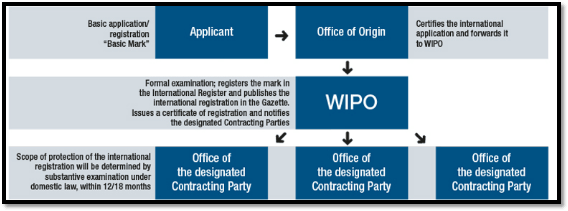
In case there is any requirement that is not complied with, the TMR will send an E-mail mentioning the requirement. The rectification of this requirement has to be within one month from the date of the communication. Failing to follow compliance can lead to refusal. Once the compliance is met, the application is sent to the International Bureau for certification. The officer in charge will communicate the amount of fee payable in Swiss Francs, directly to WIPO.
If the WIPO finds any rectification required to be made due to irregularities in the application they will duly notify. The said rectifications have to be made within 3 months from the date of notification. The Madrid protection only extends for a period of 5 years, and if the Basic Application ceases to affect the expiry of 5 years the same must be communicated to WIPO.
If the WIPO finds any rectification required to be made due to irregularities in the application they will duly notify. The said rectifications have to be made within 3 months from the date of notification. The Madrid protection only extends for a period of 5 years, and if the Basic Application ceases to affect the expiry of 5 years the same must be communicated to WIPO.
Procedure for filing the application-When India is a Contracting Party
The International Bureau is responsible for examining the applications it receives from various Trademark registries around the world. If one of the application mentions India as one of the places where they want their trademark registered, the same will be duly communicated to the Trademark Registry office.
The TMR examines the received application and objects (if any) within 18 months from the date of application. The International Bureau accepts the objection and communicates the response made about it. The TMR can decide if they accept or reject the application based on the refusal.
In case the registration is accepted, it shall be published in the Trademarks journal duly with the relevant details.
Applications under the Madrid system are rather new and developing. As India has become a member to the Madrid union recently, there are very few firms have undertaken the task of filing the application. Photon Legal is one of the few firms in the country who has the facility of filing Madrid Applications. This ensures that the best services are rendered in filing of the application.
View All

Are you trying to figure out why investors value patents? Intellectual property is undoubtedly...


Are you trying to figure out why investors value patents? Intellectual property is undoubtedly...


Are you trying to figure out why investors value patents? Intellectual property is undoubtedly...
You could spend the next 3 years following up on patent applications.
.svg)






%20(1).svg)


